What Makes a Hot Yoga Towel Actually Non-Slip? The Science of Grip, Sweat & Stability
If you've ever spent a hot yoga class pulling a towel back into place, smoothing out wrinkles or repositioning your hands because the surface underneath you shifted, you already know:
A yoga towel isn't just there to absorb sweat.
In a heated practice, your towel becomes part of your equipment. It has to manage moisture. It has to stay connected to the mat beneath it. It has to provide a consistent surface as you transition from Downward-Facing Dog to Crescent Lunge to Warrior II — and then survive the washing machine when you're finished.
At Unalome Yoga, those requirements became the starting point for how we designed our towels. But what actually determines whether a hot yoga towel performs well? It comes down to a combination of friction, moisture management, textile construction, coverage and durability.
Let's break it down.
The Two Sides of Hot Yoga Grip
When people talk about a "grippy yoga towel," they're actually describing two different interfaces.
1. Your body → the towel
Your hands and feet need a surface that can manage the moisture generated during practice without becoming a puddle underneath you.
2. The towel → your yoga mat
At the same time, the underside of the towel needs enough resistance against the mat to prevent the entire towel from sliding, folding or bunching. A towel can perform well at one and poorly at the other.
That's why simply putting an ordinary bath towel over your yoga mat rarely creates the same experience as using a towel specifically engineered for yoga.
1. Why Silicone Grip Matters
Let's start underneath the towel. Every time you transition between poses, your body transfers force through your hands and feet and into the towel below you. If the towel doesn't have enough resistance against your mat, that force can cause the fabric to move.
That's where silicone comes in.
Silicone is widely used in applications requiring flexible contact and friction, and research into textured silicone surfaces has demonstrated something particularly relevant: surface texture and contact geometry can materially influence friction, including under wet conditions. One 2025 materials study found textured silicone surfaces could increase friction under certain wet test conditions compared with smooth silicone surfaces.
That study wasn't performed on yoga towels — so we aren't claiming its laboratory results apply directly to Unalome. But the underlying principle matters:
Grip isn't simply about putting silicone somewhere on the towel. Surface area, texture and the distribution of contact points matter too.
Why Unalome Uses More Silicone Coverage
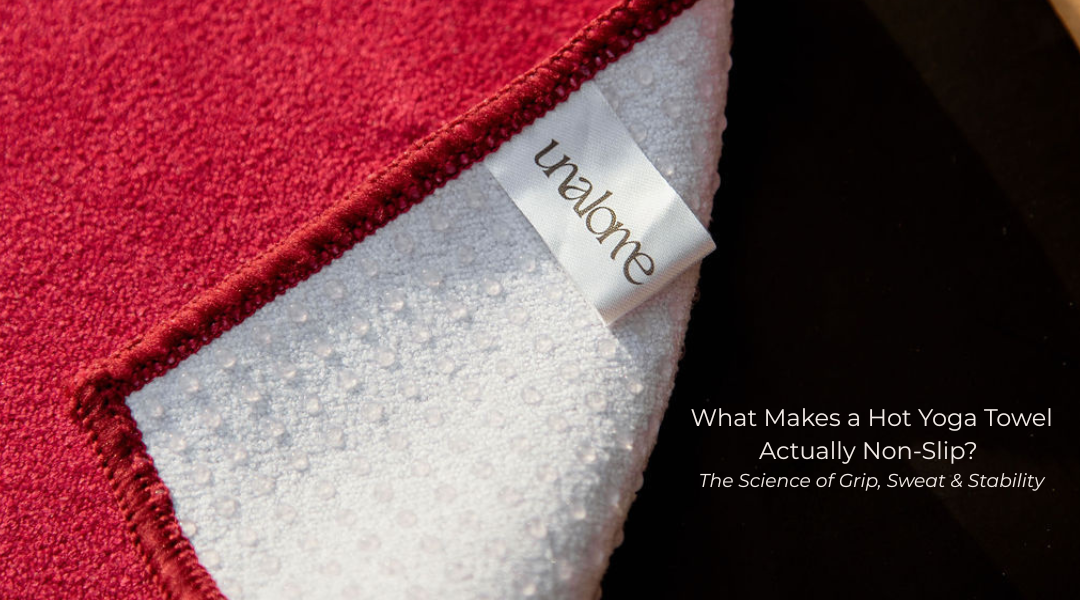
This was one of the biggest areas we focused on when developing Unalome. Our towels feature larger silicone nubs and 44% more silicone grip coverage, intentionally increasing the gripping surface underneath the towel.
In simple terms: More of the underside is designed to interact with your yoga mat.
That additional coverage helps create resistance against the mat as your weight moves across the towel during practice. And importantly, the silicone is distributed across the towel rather than existing only at a few corners or edges. Because you're not stationary during yoga. Neither should the engineering underneath you be.
Explore Unalome Non-Slip Yoga Towels →
2. Sweat Changes Everything
Hot yoga creates a very different environment from a room-temperature practice. As sweat increases, moisture begins interacting with your hands, feet, towel and mat. A high-performance towel therefore needs to do more than simply feel soft. It needs to move moisture through the textile.
Textile science refers to this as wicking: liquid moving through the small spaces and channels within a fabric through capillary forces. Research on textile moisture transport has shown that fiber structure and the capillary pathways formed between fibers influence how liquid moves through a fabric.
Research specifically examining microfiber textiles has also shown that tightly packed fine fibers can form capillary channels that transport water through fabric. That helps explain why microfiber has become such a useful material in sweat-heavy environments.
3. Why Microfiber Works So Well for Hot Yoga
Unalome towels use premium microfiber designed to be ultra-absorbent and quick-drying. Rather than letting sweat remain concentrated in one place, the structure of microfiber helps moisture spread through the textile. That matters for two reasons.
First, it helps manage sweat throughout the practice. Second, spreading moisture across more surface area can support drying compared with allowing liquid to remain pooled in one location.
Recent textile research continues to explore microfiber and capillary structures specifically for sweat management, including fabric designs that transport moisture using differences in fiber size and capillary pressure. Again, Unalome hasn't conducted those laboratory studies ourselves.
But these textile principles help explain why the construction of the fabric matters just as much as how soft it feels when you first touch it.
4. Why Weight and Structure Matter Too
Here's a detail that gets overlooked in most conversations about yoga towels: The towel itself needs enough substance to stay grounded. An extremely thin piece of fabric may feel wonderfully lightweight in your bag — but once you're moving aggressively across it, that lack of structure can become noticeable.
Unalome combines its silicone grip system with a heavier microfiber construction and 3mm overall thickness. The goal isn't to create a bulky towel. It's to create enough structure that the towel feels like a stable layer over your mat rather than loose fabric floating on top of it.
Grip is a system. Silicone alone doesn't determine performance. Neither does microfiber. It's how the components work together.
5. Full-Mat Coverage Makes a Difference
Size sounds like a boring specification until you're halfway through a class and your towel has migrated six inches from where it started. Unalome towels measure 71 inches × 24 inches, providing full-length coverage across a standard yoga practice surface.
Proper coverage means you can move from the front to the back of your mat without constantly encountering a transition between towel, exposed mat and fabric again. And for hot yoga especially, consistency matters. The fewer environmental adjustments you need to make, the easier it becomes to stay focused on the actual practice.
Why a Regular Towel Isn't the Same as a Yoga Towel
Could you bring a beach towel or bath towel into hot yoga? Of course. But they're designed for a fundamentally different purpose. A bath towel is primarily intended to absorb water while relatively stationary. A purpose-built yoga towel needs to absorb moisture while also resisting forces created by moving hands, feet and body weight.
That requires an entirely different combination of properties:
- Moisture management
- Mat-side grip
- Full-surface stability
- Appropriate dimensions
- Washability
- Softness against skin
- Durability through repeated use
That's why comparing yoga towels solely by how absorbent they feel misses half the story.
6. Performance Shouldn't End After the First Few Classes
A towel can perform beautifully when it's brand new. The harder question is:
What happens after you wash it again and again?
Hot yoga products experience a demanding cycle. Sweat. Heat. Wash. Dry. Repeat. That's one reason durability has always mattered so much to us.
Unalome towels are machine washable, and we recommend cold washing without fabric softener or dryer sheets to help preserve the towel's performance and longevity. And there's another test of durability that matters enormously to us: commercial studio use.
What Happens When a Hot Yoga Studio Uses the Same Towels Every Day?
These aren't towels sitting neatly on a retail shelf. Students use them. They sweat on them. The towels are collected. Commercially washed. Returned to rotation. And used again.
Ritual's leadership selected Unalome after looking for improved grip, quality and durability in an environment where towels need to withstand far more demanding use than most individually owned products. For us, that's one of the most meaningful validations of our product.
Performance isn't only about how a towel feels during its first class.
It's about whether you can trust it enough to make it part of your practice again and again.
Read the Ritual Hot Yoga + Unalome Story →
7. What About Dyes and Skin Contact?
This matters more than people often realize. During hot yoga, your skin spends significant time directly against the towel. Your forehead may rest on it in Child's Pose. Your cheek may touch it during Savasana. Your hands, feet, arms and legs interact with the textile throughout the entire class.
Unalome towels use AZO-certified dyes and eco-conscious dyeing methods, while maintaining the soft microfiber surface against the skin. Performance matters. But the tactile experience matters too. A towel doesn't need to feel industrial simply because it's engineered to perform.
What Should You Look for When Buying a Hot Yoga Towel?
If you're comparing yoga towels, don't evaluate them based solely on pattern or softness. Look at the entire performance system.
| Feature | Why it matters | Unalome design |
|---|---|---|
| Silicone backing | Helps resist movement between towel and mat | Larger silicone nubs + 44% more grip coverage |
| Microfiber construction | Helps manage moisture during sweaty practices | Premium ultra-absorbent, quick-drying microfiber |
| Fabric structure | Supports stability and comfort | Heavier microfiber + 3mm construction |
| Full-mat sizing | Creates a consistent practice surface | 71" × 24" |
| Washability | Essential after high-sweat classes | Machine washable |
| Dye process | Relevant with prolonged skin contact | AZO-certified dyes |
| Real-world durability | Indicates performance beyond initial use | Selected for high-volume commercial studio use |
Unalome's published product specifications support these features across its current yoga towel collection.
What Is the Best Yoga Towel for Heavy Sweating?
If you sweat heavily during yoga, prioritize two things simultaneously: moisture management on top and physical grip underneath. Absorbency alone won't stop an entire towel from shifting across a mat. And silicone backing alone doesn't solve the moisture accumulating under your hands and feet.
For high-sweat practices like hot yoga, heated Vinyasa, Yoga Sculpt and mat Pilates, look for a towel that combines:
- absorbent microfiber
- substantial silicone coverage
- full-mat dimensions
- a fabric weight that remains stable during movement
- easy washability
That's the performance combination Unalome was intentionally built around.
Shop Premium Non-Slip Hot Yoga Towels →
The Best Yoga Towel Is the One You Stop Thinking About
For all this talk about material science, friction and microfiber, our design philosophy is actually incredibly simple. We don't want you thinking about your towel during yoga. We want you thinking about your breath. Your body. Your alignment. The teacher's voice. The moment where the outside world gets a little quieter.
Slipping hands, folding fabric and constant readjustments may seem small. But small distractions pull us out of practice. That's why we care so much about what happens underneath you. The silicone. The microfiber. The dimensions. The weight. The durability. Because when all of those things work together, something interesting happens:
And your practice gets to take center stage. That's the entire point.
Frequently Asked Questions About Hot Yoga Towels
What makes a yoga towel non-slip?
A non-slip yoga towel typically combines a moisture-managing fabric surface with a gripping structure underneath. Silicone backing can create additional friction between the towel and yoga mat, while microfiber helps manage sweat on the upper surface.
Are silicone-backed yoga towels better for hot yoga?
They can be particularly useful for practitioners who experience towel movement or bunching because silicone creates additional contact between the towel and mat. Performance still depends on factors including silicone coverage, surface texture, towel construction and the mat underneath.
Is microfiber good for hot yoga?
Microfiber is widely used for moisture-management applications because fine fiber structures can create capillary pathways that transport liquid through textile structures.
Why does my yoga towel keep sliding?
Possible reasons include insufficient grip underneath the towel, an overly lightweight construction, incomplete mat coverage, moisture or residue on the mat, and the interaction between the specific towel and mat surfaces.
Should I wet my yoga towel before class?
That depends on the towel's design. Some yoga towels rely primarily on moisture-activated surface grip and may work better when slightly dampened. Silicone-backed towels use physical contact between the silicone and mat to help resist movement, so pre-wetting isn't inherently required for that mat-side gripping mechanism.
Can hot yoga towels go in the washing machine?
Unalome yoga towels are machine washable. We recommend cold water and avoiding dryer sheets or fabric softener, which can leave residues on technical textiles. Hang drying is recommended for preserving quality, although Unalome towels are also dryer-safe.
What size is an Unalome yoga towel?
Unalome's full-length yoga towels measure 71 × 24 inches and are approximately 3mm thick, designed to provide full practice coverage.
How much silicone grip does an Unalome towel have?
Unalome's current towels feature 44% more silicone grip coverage along with larger silicone nubs and a heavier microfiber construction.